
Staff stability
Improving
Source: Kolada (municipality-aggregated certified teacher trend).

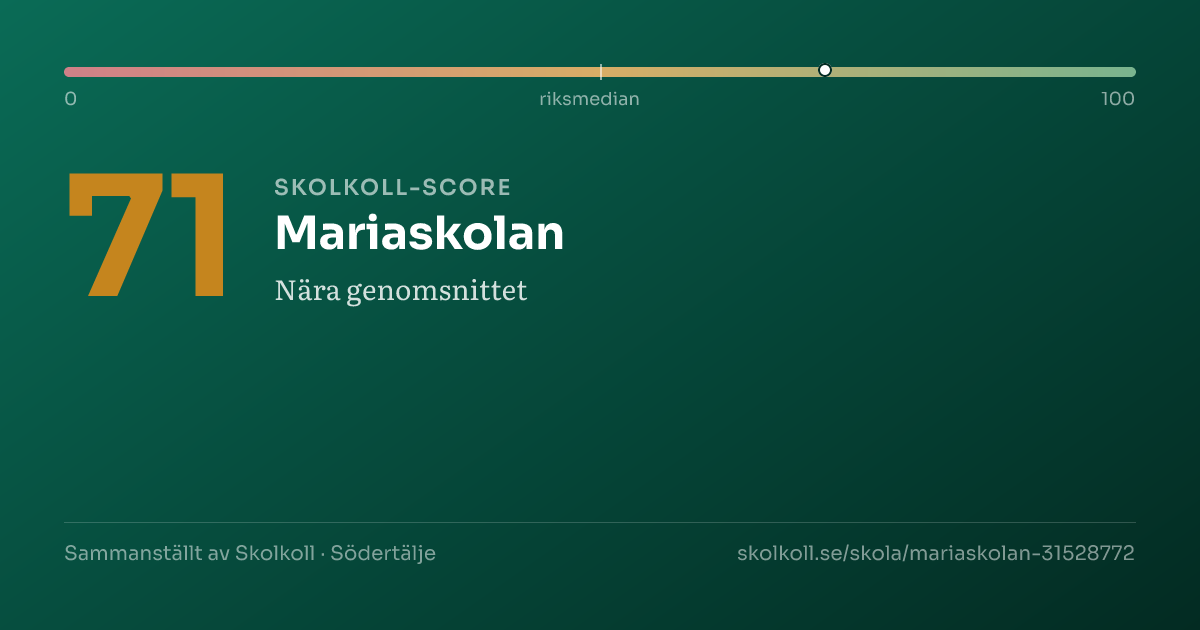
A composite of five open data sources — a starting point, not a grade.
The score reflects results directly. Given the pupil intake, the school performs better than expected — see value-added.
Skolkoll score is Skolkoll's composite indicator based on available data sources. It is not an official quality measure and should be read together with the underlying data.
3 of 5 score dimensions have school-specific data.
When school-specific data is missing for a dimension, the neutral value 50 is used. That does not automatically lower the school, but it makes the score less informative.
Performs better than the pupil intake predictsA statistical model that compares schools’ results with what is expected given the student composition.Read more in glossary →What is value-added?The school's own contribution given its pupil intake (Skolverket's SALSA model) — not a quality guarantee, and not comparable between years.

Mariaskolan is a medium-sized independent compulsory school with 160 pupils.
Mariaskolan is a medium-sized independent compulsory school with 160 pupils.
See how schools in Södertälje rank →
Mariaskolan is compared here with 33 other schools with the same school form in Södertälje municipality; it has 160 pupils versus the municipal average of 318.
The year-9 merit value is 249.7, 7.8 points above the municipal average and 22.1 points above the national average.
The SALSA residual (+42.0) indicates that outcomes are stronger than the model expects for the pupil composition.
Pupils per teacher is 12.0, 0.2 higher than the municipal average.
Apply for a place? Use Södertälje e-service for school choice (opens in a new window).
This applies only to the values listed here.
This value is missing in full or in part.
This affects
Other values here do not have this specific note.
No clear attention flags from key-figure deviations or the School Inspectorate's public register. Detailed inspection history is shown in the "Safety & Inspection" card below.
The school's strengths compared with all primary schools nationally.
Percentiles compare schools with each other, not individual pupils. What is a good merit value?
Source: Skolverket, Swedish Schools Inspectorate.
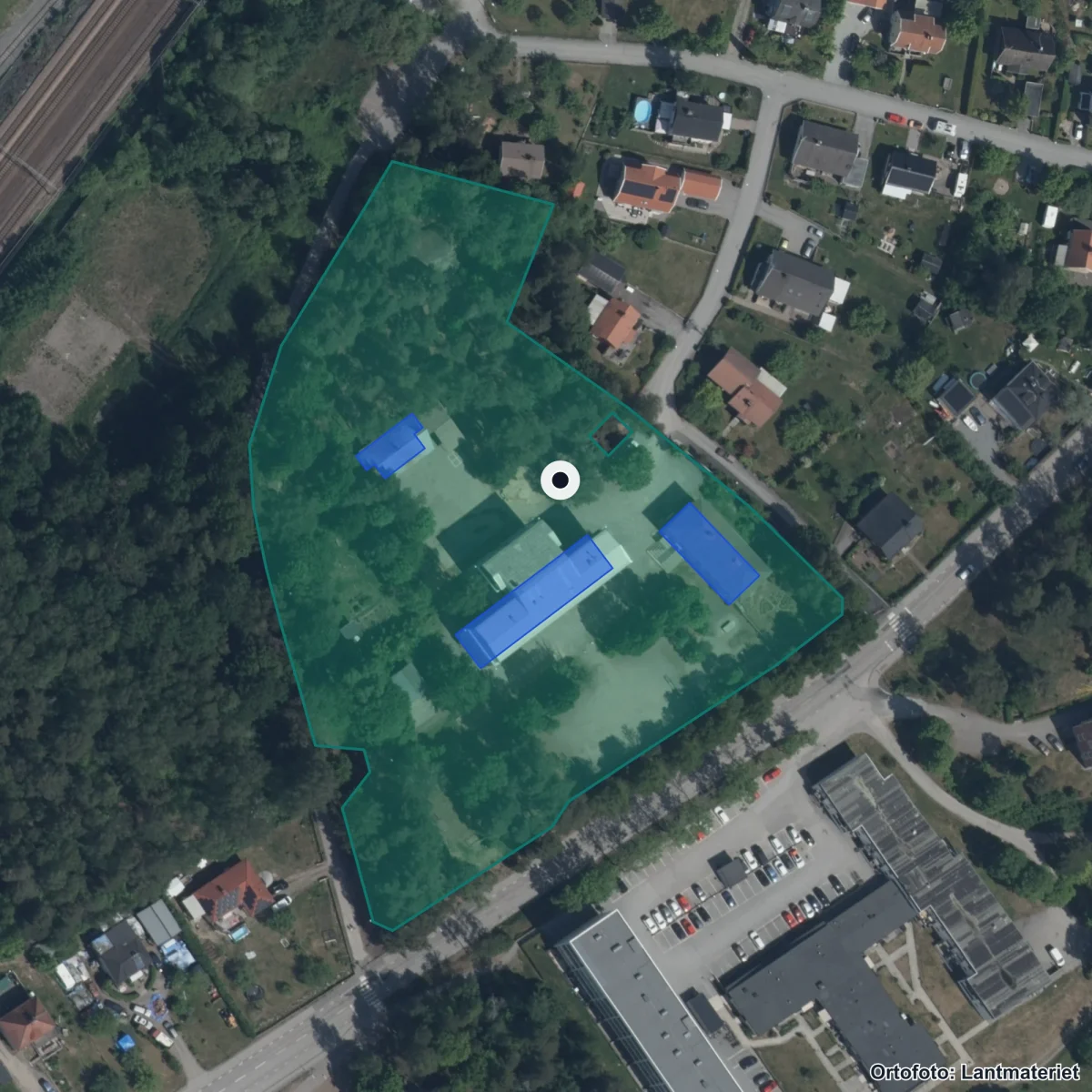
The school's property boundary and buildings from the Swedish Land Survey's property register. Updated 2026. Source: Lantmäteriet · CC BY 4.0
Entrances:1 Södertälje, Hjulåkersvägen 1, Järna
Sweden: 227.6
Municipality: 11.8 · Sweden: 11.9
Staff data reported by the school operator.
Model prediction: 242.0 · Actual outcome: 284.0
The school performs above what the student composition would predict.
1 registered inspection decision(s) with deficiencies.
Source: Schools Inspectorate + Skolverket · Last updated: 5 Oct 2026
Sweden: 144,800 SEK
Cost per pupil is 4% above the national average.
118 other schools in the municipality.
FÖRENINGEN MARIA MAGDALENA operates this school independently.
Source: Skolverket · Last updated: 5 Oct 2026
Apply through Södertälje e-service for school choice.
31528772Source: Skolverket School Unit Register · Pipeline-fetched on 2026-10-05.
Everyday travelAreas that reach the school within 15 minutes.
School-form averages across the municipality, with links to deep-dive sub-pages.
Source: Skolverket (aggregated school statistics).
The 5 most-similar compulsory schools based on student count, geography, teacher certification and pupil composition.
Share of pupils per grade, school year 2025/26.
Source: SIRIS/Skolverket · See full A–F distribution in the data view →
Survey results broken down by respondent group on a 0–10 scale. Groups can experience the same school very differently — notable gaps are highlighted below.
Text summary of the chart:
Pupils report lower study environment (4.7) than Guardians (6.5). (on the 0–10 scale)
Pupils often perceive the study environment as worse than guardians do — they spend the whole day in the classroom.
Pupils report lower stimulation (5.6) than Guardians (7.4). (on the 0–10 scale)
Pupils report lower safety (7.3) than Guardians (8.3). (on the 0–10 scale)
It is common for pupils to report lower safety than guardians, since adults rarely witness everyday school life.
Pupils report lower support (6.6) than Guardians (7.3). (on the 0–10 scale)
Staff results are not published per school by Skolinspektionen today, so the staff view appears only when available.
SALSA is a statistical comparison metric, not a school rating. Small cohorts and individual year groups can create uncertain signals, so read it together with pupil counts, survey data and other sources.
Source: Skolverket/SALSA · See the full comparison table →
Number of pupils per year group (total 158 pupils). Latest available year from Skolverket (SIRIS).
Get email when new statistics are published, merit value changes significantly or the School Inspectorate makes a new decision.
The Data view shows complete history, sources, methodology and CSV export.
Source: Kolada (municipality-aggregated certified teacher trend).
Source: Skolverket SIRIS + Skolverket Statistical Database.
Trend over time
Trends are shown only when the same indicator and source has at least two comparable years. Missing years, too few responses, and low response rates are marked.
+0.7change between first and latest comparable year
Source: Pupils year 8 · missing years: 2025
+0.5change between first and latest comparable year
Source: Pupils year 8 · missing years: 2025
Weekly menus and meal provider for this school's municipality.
Meal menu provider: Skolmaten.se
Kommunen publicerar skolmenyer via skolmaten.se.
No menu provider registered for this municipality yet.
Source: municipality's own meal portal — Skolkoll does not host menu content.
Source: Skolinspektionen tillsynsregister (open data). Updated when new decisions are published. · See all decisions and review types in the data view → · Check current status at the Schools Inspectorate ↗
More context about Mariaskolan, its municipality, operator and similar schools.
Data coverage
Open school data is not complete. Use this as a checklist for what to verify with the school, provider or municipality.
Work at this school? Embed an image showing the school's Skolkoll score that links to the full profile. The image is served from Skolkoll's image host and updates when we publish a new badge for the school.
See Data view for full sources and fetch dates per source.
