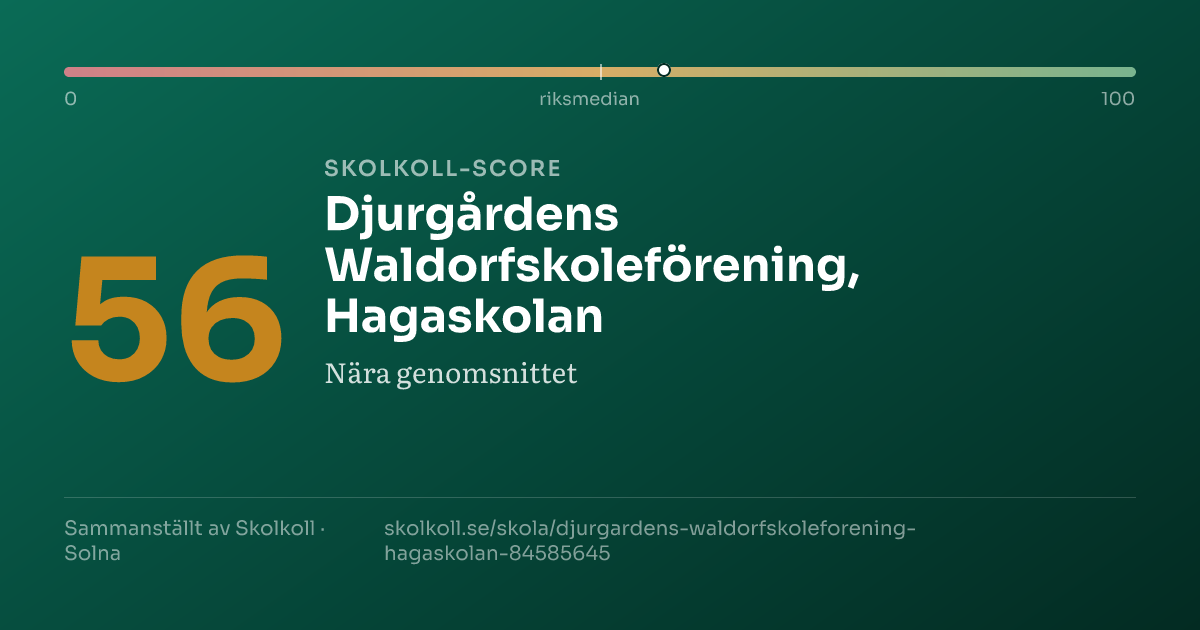
Composite indexA composite index on a 0–100 scale. The number is not a percentile or the share of schools with a lower score. 50 is the scale midpoint, not a measured national average.Skolkoll score · scale 0–100
050100
Skolkoll Score 59 out of 100. The scale goes from 0 (lowest) to 100 (highest). Composite index.
A composite of five open data sources — a starting point, not a grade.
The score reflects results directly. Given the pupil intake, the school still performs in line with expectations — see value-added.
Data coverageMedium2/5
Why this score?
Skolkoll score is Skolkoll's composite indicator based on available data sources. It is not an official quality measure and should be read together with the underlying data.
2 of 5 score dimensions have school-specific data.
When school-specific data is missing for a dimension, the neutral value 50 is used. That does not automatically lower the school, but it makes the score less informative.
→Results in line with the pupil intakeA statistical model that compares schools’ results with what is expected given the student composition.Read more in glossary →What is value-added?The school's own contribution given its pupil intake (Skolverket's SALSA model) — not a quality guarantee, and not comparable between years.
Djurgårdens Waldorfskoleförening, Hagaskolan is compared here with 20 other schools with the same school form in Solna municipality; it has 150 pupils versus the municipal average of 302.
The year-9 merit value is 243.6, 15.3 points above the municipal average and 16.0 points above the national average.
Pupils per teacher is 10.2, 2.2 lower than the municipal average.
Independent school data for all of Sweden
SCHOOL REPORT
Djurgårdens Waldorfskoleförening, Hagaskolan
Compulsory school · Year 1–9 · Solna, Stockholms County
Provider: Djurgårdens Waldorfskoleförening · School unit code: 84585645
Statistics: school year 2025/26 · Updated 2026-10-05
This staffing metric is affected by FTE definitions, local reporting practices, and temporary vacancies. For preschools without a compulsory or upper-secondary school, the same field instead holds the share of staff with pedagogical higher education (see the measure Share with pedagogical higher education).
Annual reports are not real-time data, so group links may lag behind reorganisations or recent ownership changes. Manual overrides are used only as exceptions.
SALSA is model-based and becomes less stable for small pupil groups or schools with rapidly changing pupil composition.
No clear attention flags from key-figure deviations or the School Inspectorate's public register. Detailed inspection history is shown in the "Safety & Inspection" card below.
School profile
The school's strengths compared with all primary schools nationally.
—No dataThe Swedish National Agency for Education has not published this value.No data — the Swedish National Agency for Education has not published this value.
Share of female teachers◐ Reliability: Moderate reliability.
67%
◐Moderate reliability — Mixed sources: certification + student/teacher ratio reported directly to Skolverket; other personnel fields from Skolverket's annual Personal report (1-2 year data lag).
Pupils, guardians and staff — same school, different answers
Survey results broken down by respondent group on a 0–10 scale. Groups can experience the same school very differently — notable gaps are highlighted below.
PupilsGuardians
Text summary of the chart:
Pupils: Safety 8.2, Study environment 6.0, Stimulation 6.6, Support 7.3, Anti-bullying 7.4.
Guardians: Safety 8.3, Study environment 6.8, Stimulation 7.1, Support 7.0.
Automatically flagged gaps
Δ 0.8
Pupils report lower study environment (6.0) than Guardians (6.8). (on the 0–10 scale)
Pupils often perceive the study environment as worse than guardians do — they spend the whole day in the classroom.
Δ 0.5
Pupils report lower stimulation (6.6) than Guardians (7.1). (on the 0–10 scale)
Staff results are not published per school by Skolinspektionen today, so the staff view appears only when available.
SALSA result
+7.0A statistical model that compares schools’ results with what is expected given the student composition.Read more in glossary →Performs as expectedThe residual is actual minus expected merit value; positive means the school lifts pupils more than the model predicts.
Better than 8 of 10 comparable schools.
Average residual among benchmark schools: −1.4A statistical model that compares schools’ results with what is expected given the student composition.Read more in glossary →.
How should SALSA be read?
SALSA is a statistical comparison metric, not a school rating. Small cohorts and individual year groups can create uncertain signals, so read it together with pupil counts, survey data and other sources.
Trends are shown only when the same indicator and source has at least two comparable years. Missing years, too few responses, and low response rates are marked.
Safety
-0.2change between first and latest comparable year
Source: municipality's own meal portal — Skolkoll does not host menu content.
Inspections & decisions
ℹ️This regulatory record may be outdated. Skolinspektionen has recorded a supervision entry about this school, but we currently cannot confirm how up to date it is. Check the current status at the Schools Inspectorate.
What we do not know about Djurgårdens Waldorfskoleförening, Hagaskolan
Open school data is not complete. Use this as a checklist for what to verify with the school, provider or municipality.
MediumResults and score inputsMedium data coverage: 2 of 5 score dimensions have school-specific data. When school-specific data is missing for a dimension, the neutral value 50 is used. That does not automatically lower the school, but it makes the score less informative.
MediumEligibility and goal attainmentGrades, eligibility and goal-attainment data may be missing, suppressed or available only for some grades and school types.
UncertainResources, teachers and staffTeacher and resource metrics do not always show subject mix, vacancies, student-health workflows or everyday staffing.
MissingSupport resources and student healthWe do not yet have a verified national data source for special education, student health, adaptations, language support or contact routes per school.
MissingSafety and study environmentWe lack current or displayable survey data about safety and study environment for this school.
UncertainAdmissions, placement and important datesMunicipal placement rules, queues and important dates require a local source and should be checked with the municipality or school.
MissingVisits, facilities and everyday environmentWe lack sourced open-house information for this school. Facilities, accessibility and everyday environment are often not open comparable data.
Places, admission and support are decided by the school, provider or municipality. Use this as a checklist, not a promise of outcome.
For the school: get your Skolkoll badge
Work at this school? Embed an image showing the school's Skolkoll score that links to the full profile. The image is served from Skolkoll's image host and updates when we publish a new badge for the school.
Data sources: Skolverket, Kolada (RKA/SKR), SCB · Updated 2026-10-05
Method
About this value
Cookie settings
We use cookies for visitor statistics, A/B testing and site improvement with Zoho PageSense, which may include heatmaps and session recording on public pages. Skolkoll does not sell visitor data and shows no advertising. Read more in our privacy policy