
Vallåsskolan in Halmstad
Results in line with the pupil intakeA statistical model that compares schools’ results with what is expected given the student composition.Read more in glossary →What is value-added?The school's own contribution given its pupil intake (Skolverket's SALSA model) — not a quality guarantee, and not comparable between years.

Vallåsskolan is a small municipal compulsory school.
Vallåsskolan is a small municipal compulsory school.
- Cost per pupil (municipal avg.)
- 137,744 SEKLimited history
- Sweden: 144,800 SEK
The most important facts in 3 points
- Compulsory school in Halmstad. Pupil count is missing from the latest open data.
- No current inspection decision is available in the open Schools Inspectorate data.
- The school is not active in Skolverket's register; check status before choosing.
3 values need extra caution
This applies only to the values listed here.
This value is missing in full or in part.
This affects
- Eligible for vocational programmes
- Merit score year 9
- SALSA score
- This result metric can be affected by privacy suppression, small cohorts, and changes in pupil composition between years.
- SALSA is model-based and becomes less stable for small pupil groups or schools with rapidly changing pupil composition.
Other values here do not have this specific note.
School programmes
- Compulsory school
Things to look into
Worth looking into. These indicators are an attention aid, not a quality grade or risk score.
- Merit value is 14 points lower than expected given pupil composition (SALSA score: -14.0).
Aerial view of the school
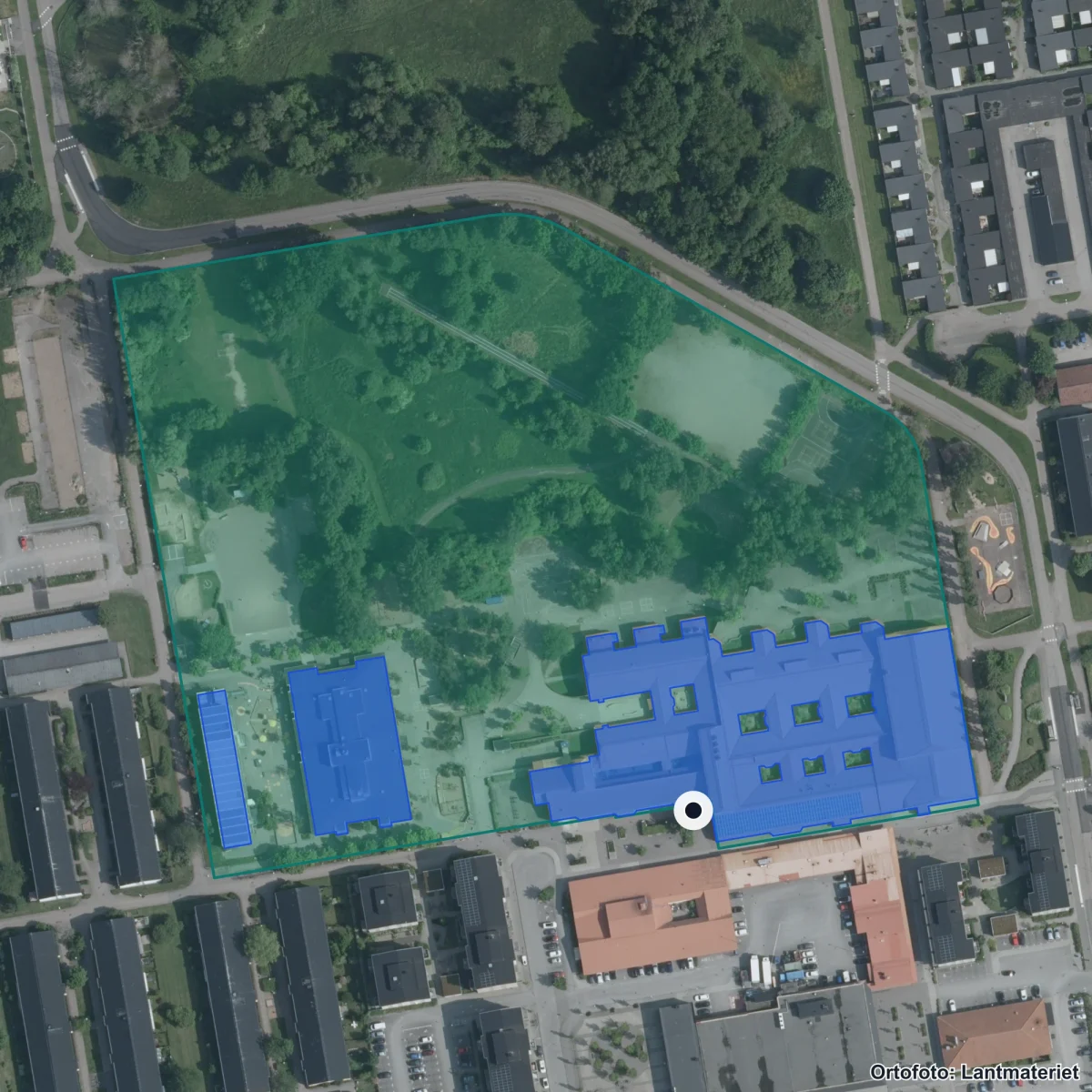
The school's property boundary and buildings from the Swedish Land Survey's property register. Updated 2026. Source: Lantmäteriet · CC BY 4.0
Entrances:1 Halmstad, Vallås torg 15, Halmstad
School performance
Staff
87%Permanently employed
Staff
87%
Permanently employed
Staff data reported by the school operator.
- Permanently employed Reliability: Moderate reliability.
- 87%
- Senior teachers (förstelärare) Reliability: Moderate reliability.
- No dataThe Swedish National Agency for Education has not published this value.No data — the Swedish National Agency for Education has not published this value.
- Pupils per counsellor Reliability: Moderate reliability.
- 1,082.0
- Certified in their teaching subject Reliability: Moderate reliability.
- 74%
- Teachers (FTE) Reliability: Moderate reliability.
- 872.1
- Share of female teachers Reliability: Moderate reliability.
- 73%
Moderate reliability — Personnel fields from Skolverket's annual Personal report (1-2 year data lag).
Source: Skolverket · Last updated: 6 Oct 2026
School environment
Safety & Inspection
No inspection documentsInspection year unknown
Safety & Inspection
No inspection documents
Inspection year unknown
We have no inspection documents for this school. Our inspection data is incomplete: it mainly covers regular and targeted inspections, and most quality reviews are still missing.
- Recorded decisions with deficiencies Reliability: High reliability.
- 0
High reliability — Inspection register and Skolenkäten survey.
Source: Schools Inspectorate + Skolverket · Last updated: 5 Oct 2026
Resources
137,744 SEKCost per pupil (total)Sweden: 144,800 SEK
Resources
137,744 SEK
Cost per pupil (total)
Cost per pupil is 5% below the national average.
Limited history — Cost data updated annually by Kolada/SCB.
Who runs the school
Operator
HALMSTADS KOMMUNMunicipal operator166 other schools in the municipality.
Operator
HALMSTADS KOMMUN
Municipal operator

HALMSTADS KOMMUN is the operator. The municipality has 166 other schools.
- Operator Reliability: High reliability.
- HALMSTADS KOMMUN
- Operating form Reliability: High reliability.
- Municipal own operation
- Other schools in municipality Reliability: High reliability.
- 166
High reliability — Current data from Skolverket and Bolagsverket.
Source: Skolverket · Last updated: 6 Oct 2026
Contact and address
- Visiting address
- Vallås centrum, 30252 Halmstad
- Postal address
- BOX 153, 30105 HALMSTAD
- Phone
- 035-137583
- School unit code
64559541
Source: Skolverket School Unit Register · Pipeline-fetched on 2026-10-06.
Everyday travelAreas that reach the school within 15 minutes.
Reachability from the school
15 min on foot
15 min by bike
School
Support and inclusion
Support and student health
This panel shows sourced support-resource data where available and marks the rest as missing or uncertain. These fields do not affect score or ranking.
Missing or uncertain support-resource fields
- MissingStudent health teamIs there sourced information about student health functions at the school?
- PartialSpecial educatorThe source does not split special educators and special needs teachers per school unit in this model.
- PartialSpecial needs teacherThe source does not split special educators and special needs teachers per school unit in this model.
- MissingSchool nurseIs there sourced information about school nurse resources?
- MissingPsychologistIs there sourced information about psychologist resources?
- MissingStudy and career guidanceIs there sourced information about study and career guidance?
- MissingLanguage supportIs there sourced information about language or mother-tongue support?
- MissingAdaptations and special supportIs there verified process information for adaptations and special support?
- MissingAccessibilityIs there sourced information about physical or pedagogical accessibility?
- MissingContact routeIs there a verified contact route for support questions?
Privacy rule: no individual pupil health, diagnosis, support decision or personal case data may be stored.
Nearest and similar schools
- Snöstorpsskolan F-51 km away· 320 pupils
- Andersbergsskolan F-32 km away· 190 pupils
- Furulundsskolan 7-92 km away· 230 pupils
About Halmstad municipality
School-form averages across the municipality, with links to deep-dive sub-pages.
- Schools
- 166
- Avg. merit (yr 9)
- 231.2+3.6
- Certified teachers
- 79%+6 pp
- Pupils per teacher
- 12.1in line
Source: Skolverket (aggregated school statistics).
Similar schools
The 5 most-similar compulsory schools based on student count, geography, teacher certification and pupil composition.
School survey perspectives
Pupils, guardians and staff — same school, different answers
Survey results broken down by respondent group on a 0–10 scale. Groups can experience the same school very differently — notable gaps are highlighted below.
PupilsGuardians
Text summary of the chart:
- Pupils: Safety 8.3, Study environment 5.3, Stimulation 5.6, Support 6.9, Anti-bullying 5.5.
- Guardians: Safety 6.7, Study environment 4.2, Stimulation 5.7, Support 5.7.
Automatically flagged gaps
Guardians report lower safety (6.7) than Pupils (8.3). (on the 0–10 scale)
Guardians report lower support (5.7) than Pupils (6.9). (on the 0–10 scale)
Guardians report lower study environment (4.2) than Pupils (5.3). (on the 0–10 scale)
Staff results are not published per school by Skolinspektionen today, so the staff view appears only when available.
SALSA result
−14.0A statistical model that compares schools’ results with what is expected given the student composition.Read more in glossary →Performs as expectedThe residual is actual minus expected merit value; positive means the school lifts pupils more than the model predicts.
How should SALSA be read?
SALSA is a statistical comparison metric, not a school rating. Small cohorts and individual year groups can create uncertain signals, so read it together with pupil counts, survey data and other sources.
Source: Skolverket/SALSA · See the full comparison table →
Pupils per year
Number of pupils per year group (total 234 pupils). Latest available year from Skolverket (SIRIS).
★ Watch Vallåsskolan
Get email when new statistics are published, merit value changes significantly or the School Inspectorate makes a new decision.
Want to dig deeper?
The Data view shows complete history, sources, methodology and CSV export.
In-depth metrics
Staff stability
Stable
Source: Kolada (municipality-aggregated certified teacher trend).
Throughput year 6 → year 9
67.9% → 66.4%
- 75 pupils yr 9
Source: Skolverket SIRIS + Skolverket Statistical Database.
Explore further
More context about Vallåsskolan, its municipality, operator and similar schools.
Compulsory schools in HalmstadSee all compulsory schools in the municipality with results and comparisons.Schools in HalmstadOpen the municipality page with all schools, rankings, and local aggregates.Halmstads kommunSee all schools, municipalities, and core metrics for the same provider.Hallands länCompare municipalities and school patterns across the whole county.Merit value year 9Compare year-9 merit values across municipalities and school environments.Certification vs Merit valueSee how the share of certified teachers relates to year-9 merit values.Compare schoolsBuild a side-by-side comparison with the schools you care about.
Data coverage
What we do not know about Vallåsskolan
Open school data is not complete. Use this as a checklist for what to verify with the school, provider or municipality.
- MissingResults and score inputsSkolkoll score is not shown for this school type or lacks enough underlying data.
- MissingEligibility and goal attainmentGrades, eligibility and goal-attainment data may be missing, suppressed or available only for some grades and school types.
- UncertainResources, teachers and staffTeacher and resource metrics do not always show subject mix, vacancies, student-health workflows or everyday staffing.
- PartialSupport resources and student healthSome support-resource fields have sourced statistics, but several parts are still missing or reported only in aggregate.
- MissingSafety and study environmentWe lack current or displayable survey data about safety and study environment for this school.
- UncertainAdmissions, placement and important datesMunicipal placement rules, queues and important dates require a local source and should be checked with the municipality or school.
- MissingVisits, facilities and everyday environmentWe lack sourced open-house information for this school. Facilities, accessibility and everyday environment are often not open comparable data.
See Data view for full sources and fetch dates per source.
