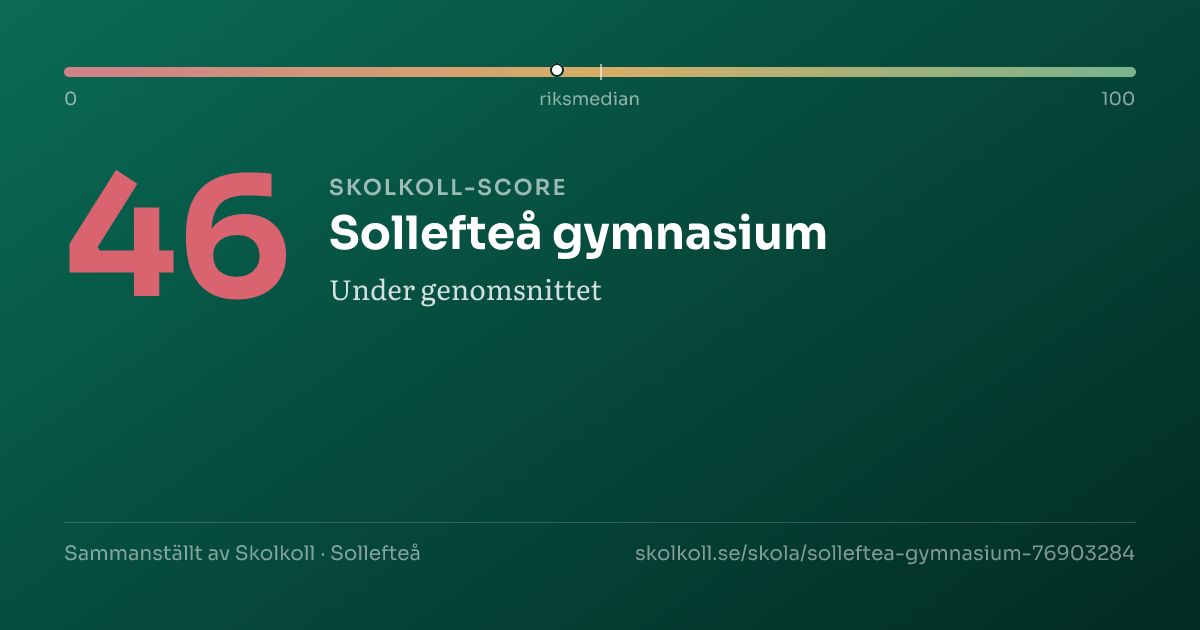
Composite indexA composite index on a 0–100 scale. The number is not a percentile or the share of schools with a lower score. 50 is the scale midpoint, not a measured national average.Skolkoll score · scale 0–100
050100
Skolkoll Score 50 out of 100. The scale goes from 0 (lowest) to 100 (highest). Composite index.
A composite of five open data sources — a starting point, not a grade.
Data coverageMedium3/5
Why this score?
Skolkoll score is Skolkoll's composite indicator based on available data sources. It is not an official quality measure and should be read together with the underlying data.
3 of 5 score dimensions have school-specific data.
When school-specific data is missing for a dimension, the neutral value 50 is used. That does not automatically lower the school, but it makes the score less informative.
Sollefteå gymnasium is a large municipal upper secondary school with 590 pupils.
Sollefteå gymnasium is a large municipal upper secondary school with 590 pupils. The share of qualified teachers (65%) is below the national average of 78%. Skolverket: unweighted school-unit mean, upper-secondary schools with published data; latest available value per school.
Pupils
590●High reliability
Municipality: 590
Qualified teachers
65%●High reliability
Sweden: 78% (Skolverket: unweighted school-unit mean, upper-secondary schools with published data; latest available value per school)
There is still too little history to interpret the trend safely.
This affects
Certified teachers
Cost per student
Pupils per teacher
Number of pupils
This staffing metric is affected by FTE definitions, local reporting practices, and temporary vacancies. For preschools without a compulsory or upper-secondary school, the same field instead holds the share of staff with pedagogical higher education (see the measure Share with pedagogical higher education).
Costs are affected by accounting practices, rent levels, and service mix, and should mainly be compared across similar school types.
This staffing metric is affected by FTE definitions, local reporting practices, and temporary vacancies.
Pupil counts may be privacy-suppressed for small units and are not always updated on the same cadence as other indicators.
14.3▲ +0.2From 14.1 (2324) to 14.3 (2425)Sweden: 14.0
Examination rate (3 yr)● Reliability: High reliability.
71.9%Sweden: 78.3%
Eligible for higher education● Reliability: High reliability.
58.0%Sweden: 68.3%
After graduation (3 years)
Outcome
Share
In further studies (national programmes)
35.4%
Established in the labor market (national programmes)
49.6%
Established in the labor market (introduction programmes)
41.7%
Source: Skolverket Statistikdatabasen (per school unit, 3 years after graduation). Rows are independent outcome metrics and do not sum to 100%. One-year follow-up and a university-vs-other-studies split are not published in open data per school.
◐Moderate reliability — Mixed sources: results reported directly by the school operator; post-graduation outcomes (3 years) from Skolverket Statistikdatabasen.
We have no inspection documents for this school. Our inspection data is incomplete: it mainly covers regular and targeted inspections, and most quality reviews are still missing.
Recorded decisions with deficiencies● Reliability: High reliability.
0
●High reliability — Inspection register and Skolenkäten survey.
Source: Schools Inspectorate + Skolverket · Last updated: 5 Oct 2026
Trends are shown only when the same indicator and source has at least two comparable years. Missing years, too few responses, and low response rates are marked.
Safety
+0.2change between first and latest comparable year
20248.5
20268.7
Source: Pupils upper-sec. year 2 · missing years: 2025
Study environment
+0.5change between first and latest comparable year
20246.7
20267.2
Source: Pupils upper-sec. year 2 · missing years: 2025
School meals
Weekly menus and meal provider for this school's municipality.
No menu provider registered for this municipality yet.
Open school data is not complete. Use this as a checklist for what to verify with the school, provider or municipality.
MediumResults and score inputsMedium data coverage: 3 of 5 score dimensions have school-specific data. When school-specific data is missing for a dimension, the neutral value 50 is used. That does not automatically lower the school, but it makes the score less informative.
MediumEligibility and goal attainmentGrades, eligibility and goal-attainment data may be missing, suppressed or available only for some grades and school types.
UncertainResources, teachers and staffTeacher and resource metrics do not always show subject mix, vacancies, student-health workflows or everyday staffing.
MissingSupport resources and student healthWe do not yet have a verified national data source for special education, student health, adaptations, language support or contact routes per school.
MissingSafety and study environmentWe lack current or displayable survey data about safety and study environment for this school.
UncertainAdmissions, placement and important datesMunicipal placement rules, queues and important dates require a local source and should be checked with the municipality or school.
MissingVisits, facilities and everyday environmentWe lack sourced open-house information for this school. Facilities, accessibility and everyday environment are often not open comparable data.
Places, admission and support are decided by the school, provider or municipality. Use this as a checklist, not a promise of outcome.
For the school: get your Skolkoll badge
Work at this school? Embed an image showing the school's Skolkoll score that links to the full profile. The image is served from Skolkoll's image host and updates when we publish a new badge for the school.
Data sources: Skolverket, Kolada (RKA/SKR), SCB · Updated 2026-10-06
Method
About this value
Cookie settings
We use cookies for visitor statistics, A/B testing and site improvement with Zoho PageSense, which may include heatmaps and session recording on public pages. Skolkoll does not sell visitor data and shows no advertising. Read more in our privacy policy