Staff stability
Declining
Source: Kolada (municipality-aggregated certified teacher trend).

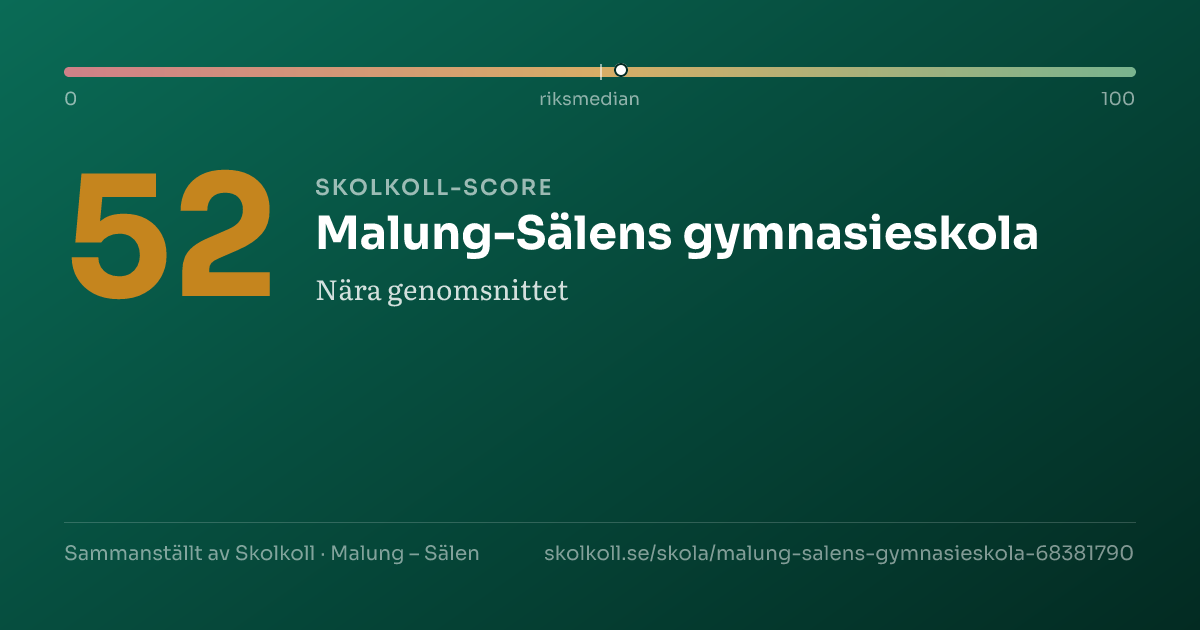
A composite of five open data sources — a starting point, not a grade.
Skolkoll score is Skolkoll's composite indicator based on available data sources. It is not an official quality measure and should be read together with the underlying data.
4 of 5 score dimensions have school-specific data.
When school-specific data is missing for a dimension, the neutral value 50 is used. That does not automatically lower the school, but it makes the score less informative.
Malung-Sälens gymnasieskola is a medium-sized municipal upper secondary school with 310 pupils.
Malung-Sälens gymnasieskola is a medium-sized municipal upper secondary school with 310 pupils. The share of qualified teachers (76%) is below the national average of 78%. Skolverket: unweighted school-unit mean, upper-secondary schools with published data; latest available value per school.
See how schools in Malung – Sälen rank →
Apply for a place? Use Malung – Sälen e-service for upper-secondary application (opens in a new window).
This applies only to the values listed here.
There is still too little history to interpret the trend safely.
This affects
Other values here do not have this specific note.
No clear attention flags from key-figure deviations or the part of the School Inspectorate's register we import. Detailed inspection history is shown in the "Safety & Inspection" card below.
The school's strengths compared with all upper-secondary schools nationally.
Source: Skolverket, Swedish Schools Inspectorate.
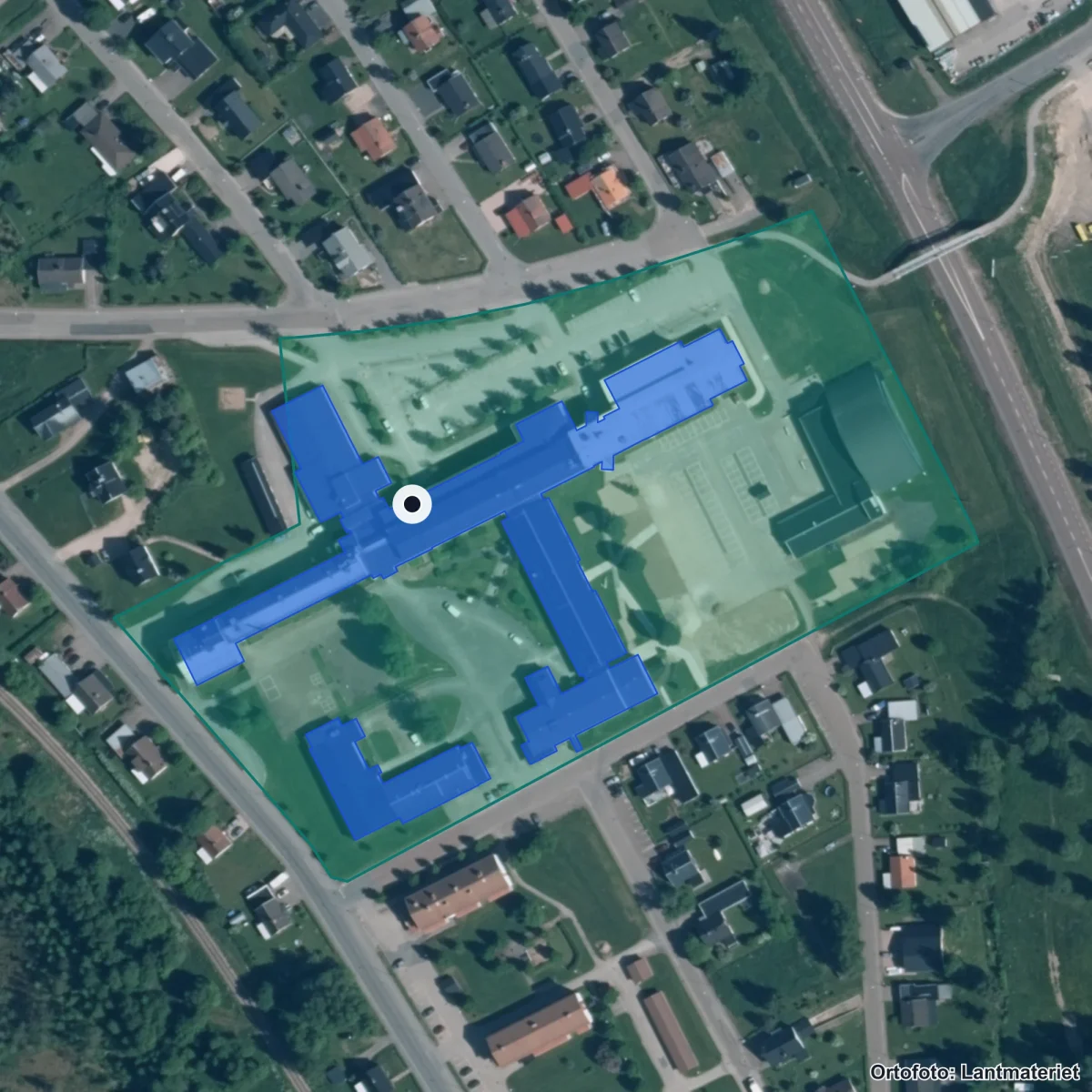
The school's property boundary and buildings from the Swedish Land Survey's property register. Updated 2026. Source: Lantmäteriet · CC BY 4.0
Entrances:1 Malung-Sälen, Västra Bangatan 20, Malung
Sweden: 14.0
Average graduation grade is 0.1 points above the national average.
| Programme | Avg. | Sweden | Difference |
|---|---|---|---|
| Bygg- och anläggningsprogrammet | 107.5 p · Historical 2025 | — | |
| El- och energiprogrammet | 162.5 p · Historical 2025 | — | |
| Ekonomiprogrammet | 182.5 p · Historical 2025 | — | |
| Försäljnings- och serviceprogrammet | 160 p · Historical 2025 | — | |
| Hotell- och turismprogrammet | 200 p · Historical 2025 | — | |
| Naturvetenskapsprogrammet | 252.5 p · Historical 2025 | — | |
| Samhällsvetenskapsprogrammet | 190 p · Historical 2025 | — |
Lowest admitted merit score from the most recent published admission round; the year is stated per programme. Scores marked "average" are Skolverket's average admission score, published when the lowest admitted score is unavailable. Smaller programmes (under 20 places) have larger year-to-year variation.
| Outcome | Share |
|---|---|
| In further studies (national programmes) | 27.5% |
| Established in the labor market (national programmes) | 56.0% |
Source: Skolverket Statistikdatabasen (per school unit, 3 years after graduation). Rows are independent outcome metrics and do not sum to 100%. One-year follow-up and a university-vs-other-studies split are not published in open data per school.
Sweden: 78% · Skolverket: unweighted school-unit mean, upper-secondary schools with published data; latest available value per school
76% certified teachers — 2 percentage points below the national average.
Safety index: 76 / 100
3 registered inspection decision(s) with deficiencies. We could not classify 2 of 5 inspection documents. Latest document: 2022. Our inspection data is incomplete: it mainly covers regular and targeted inspections, and most quality reviews are still missing.
| Dimension | Pupils (gy 2) | Guardian | Staff |
|---|---|---|---|
| Safety | 8.8 / 10 | — | — |
| Study environment | 6.5 / 10 | — | — |
| Anti-bullying | 6.9 / 10 | — | — |
| Stimulation | 6.3 / 10 | — | — |
| Support | 7.1 / 10 | — | — |
Scale 0–10 (rescaled from Skolverket's 0–100). Guardian and staff perspectives are often not in open data.
Source: Schools Inspectorate + Skolverket · Last updated: 5 Oct 2026
Sweden: 144,800 SEK
Cost per pupil is 7% above the national average.
19 other schools in the municipality.

MALUNG-SÄLENS KOMMUN is the operator. The municipality has 19 other schools.
Source: Skolverket · Last updated: 6 Oct 2026
Apply through Malung – Sälen e-service for upper-secondary application.
68381790Source: Skolverket School Unit Register · Pipeline-fetched on 2026-10-06.
Everyday travelAreas that reach the school within 15 minutes.
School-form averages across the municipality, with links to deep-dive sub-pages.
Source: Skolverket (aggregated school statistics).
The 5 most-similar upper secondary schools based on student count, geography, teacher certification and pupil composition.
Get email when new statistics are published, merit value changes significantly or the School Inspectorate makes a new decision.
The Data view shows complete history, sources, methodology and CSV export.
Source: Kolada (municipality-aggregated certified teacher trend).
The school survey shows pupil experience where responses are available. Read values together with year, response coverage and unknowns.
Coverage: 1 displayed year group · year 2026.
Support-needs policy · School-choice guide
Source: Skolinspektionen Skolenkäten 2026. Updated annually. · See all years and dimensions in the data view →
Weekly menus and meal provider for this school's municipality.
No menu provider registered for this municipality yet.
Source: municipality's own meal portal — Skolkoll does not host menu content.
Source: Schools Inspectorate decisions via Skolverket's document archive (SIRIS). Our inspection data is incomplete: it mainly covers regular and targeted inspections, and most quality reviews are still missing. · See all decisions and review types in the data view → · Search all decisions and reviews at the Schools Inspectorate (in Swedish) ↗
Applicants per place and latest admission cutoff per programme (2025).
High demand reflects popularity, which depends on location and reputation as well as quality. Cutoffs measure entry difficulty, not school quality.
Source: Gymnasieantagningen (regional admission databases). Latest year: 2025.
Source: Skolverket (graduation rate within 3 years). Updated annually.
Source: Skolverket (higher-education eligibility).
More context about Malung-Sälens gymnasieskola, its municipality, operator and similar schools.
Data coverage
Open school data is not complete. Use this as a checklist for what to verify with the school, provider or municipality.
Work at this school? Embed an image showing the school's Skolkoll score that links to the full profile. The image is served from Skolkoll's image host and updates when we publish a new badge for the school.
See Data view for full sources and fetch dates per source.
