Kangos Kultur- o ekologiskola in Pajala

After-school care, Compulsory school, Preschool class — Year 1–9 in Pajala, Norrbottens län · KANGOS KULTUR OCH EKOLOGISKOLA

3 values need extra caution

This applies only to the values listed here.

This value is missing in full or in part.

This affects

  • Eligible for vocational programmes
  • Group name
  • Merit score year 9
  • This result metric can be affected by privacy suppression, small cohorts, and changes in pupil composition between years.
  • Annual reports are not real-time data, so group links may lag behind reorganisations or recent ownership changes. Manual overrides are used only as exceptions.

Other values here do not have this specific note.

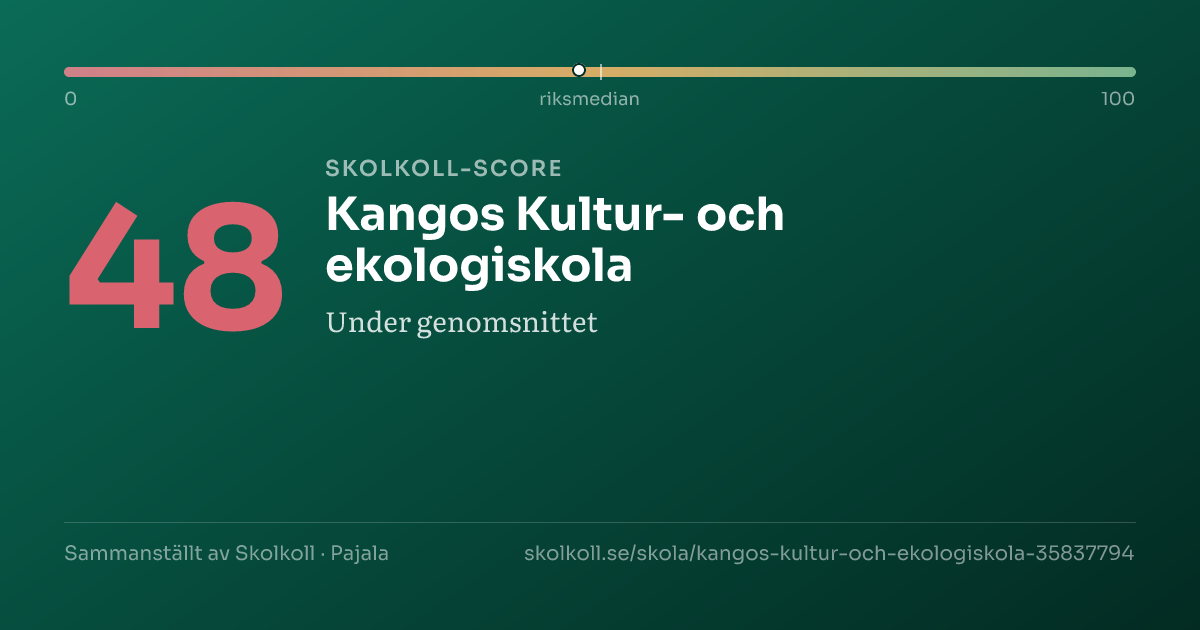
Skolkoll score: 48 of 100 How is it calculated?
This school performs below average
50 pupils 45.4% qualified teachers 6.5 pupils/teacher 1 warning signal
Quality dimensions
Results* 50
Staff 4
Value-added* 50
Safety 83
Resources 97
* Missing school-specific data — using national median (50). Based on 3 of 5 dimensions.

Kangos Kultur- o ekologiskola is a compulsory school in Pajala, Norrbottens län. The school has 50 pupils and 6.5 pupils per teacher. 45.4% of teachers are qualified. Provider The organisation that runs the school — a municipality, foundation or limited company.Read more in glossary → : Kangos Kultur Och Ekologiskola.

Statistics: school year 2023/24. Source: Skolverket, SCB, Kolada. Glossary · About the data.

Skip table of contents

Visits

Open house and visiting days

Verified dates for visiting this school.

No verified open house dates are registered yet.

Send a date

Suggest an open house date

Dates are added from school-provided or editorially verified sources after manual review.

Warning signals

Objective assessment based on statistics — not a quality stamp. Glossary.

1 warning signal identified
Low share of qualified teachers 45%

45% qualified teachers — significantly below the national average (74%).

School signal summary

Above average
compared to national averages
Pupils/teacher
6.5
National: 12.1 Municipality: 8.0
Qualified teachers
45.4%
National: 74.0% Municipality: 54.1%
School National Municipality

School profileSchool strengths and profile

School's strengths compared to all compulsory schools nationally. Source: Skolverket, Schools Inspectorate. Method.

Percentile ranking

School's position among all compulsory schools in Sweden.

Qualified teachers P4
Teacher density P97

Safety index

83 /100 (low certainty)
Staff 83%

Cost per pupil The municipality’s total cost for compulsory school per student per year. Ranges from under SEK 100,000 to over SEK 200,000.Read more in glossary → — Pajala

Municipality average cost per pupil. Source: Kolada.

204,793 SEK Total cost/pupil National avg: 142,155 SEK
102,071 SEK Teaching
27,083 SEK Facilities
12,506 SEK Meals
4,159 SEK Learning materials
6,825 SEK Student health

Municipal schools: 181,665 SEK/pupil. This school is run by an independent provider and receives a pupil allowance from the municipality.

Student support services Collective term for the school’s medical, psychological, psychosocial, and special-educational services.Read more in glossary → in Pajala

Municipality-level data on student health and support resources. Source: Kolada and the Schools Inspectorate.

Student health, compulsory school
6,825 SEK/pupil (national: 5,053 SEK)
Easy access to student health, yr 5
59.2%
Support from student health (staff)
68.8%

View all key figures for Pajala · Source: Kolada

After-school care in Pajala

Municipality-level key figures for after-school care (fritidshem) in Pajala. The data covers the entire municipality and may differ from this specific unit.

Children per FTE
15 (national: 21.6)
Pedagogical higher education
28% (national: 36.7%)
Cost per child
55,335 SEK/year (national: 46,712 SEK)
Enrolment rate (age 6-12)
35.7% (national: 57.9%)
Enrolled children in municipality
128

View all key figures for Pajala · Source: Kolada

Student forecast — Pajala

Population forecast for children ages 6–15 in Pajala. Source: SCB.

586 ages 6–15 (2025)
554 ages 6–15 (2030)
515 ages 6–15 (2035)
-5.5 % Change

Staff & stability

Staff stability and qualification data, shown first at school level and then at municipality level.

This school

Indicator based on the share of permanently employed, senior and qualified teachers. The school has moderate staff stability.

Medium
Permanently employed
73%
Senior teachers
12.5%
Qualified teachers
45.4%

Teacher turnover: 6.2% — share of teachers who left or joined during the year

Municipal average qualified teachers: 54.1% (national: 74%).

A high share of permanently employed and qualified teachers indicates a more stable staff situation. Source: Skolverket Statistical Database.

Municipality

How stable the teaching workforce is in the municipality, measured as the trend in the share of qualified teachers over time. Municipality-level data from Kolada. School-specific trend is shown above under This school.

Qualified teachers The proportion of teachers with a teaching licence and qualification in the subjects they teach.Read more in glossary → — Pajala (2025)
61.5% (national: 73.3%)
Qualification trend (2020–2025)
↑ +5.9 percentage points (improving)
Pupils per teacher — Pajala
8.5 (national: 11.9)

Trend: qualified teachers in Pajala (%)

2020: 55.6% 2025: 61.5%

All staff data for Pajala

Similar schools

The 5 most similar compulsory schools based on pupil count, geography, teacher qualifications and pupil composition.

Student throughput The proportion of upper secondary students who graduate within three years. An important quality measure for upper secondary schools.Read more in glossary →

Proxy: difference in pass rate (all subjects) year 6 vs year 9.

8 Pupils yr 6
2 Pupils yr 9

Pupils per year group

Year 1
3
Year 2
4
Year 3
7
Year 4
5
Year 5
6
Year 6
8
Year 7
5
Year 8
8
Year 9
2

Statistics

Number of pupils
50 Limited historyThere is still too little history to interpret the trend safely.This affectsNumber of pupilsPupil counts may be privacy-suppressed for small units and are not always updated on the same cadence as other indicators.Read more about the method →
Pupils per teacher
6.5 (municipal avg: 8, national: 12.1)
Qualified teachers
45.4% (municipal avg: 54.1%, national: 74%)
Merit value yr 9
Partial missingnessThis value is missing in full or in part.This affectsMerit score year 9This result metric can be affected by privacy suppression, small cohorts, and changes in pupil composition between years.Read more about the method →
Eligible for vocational upper secondary yr 9
Partial missingnessThis value is missing in full or in part.This affectsEligible for vocational programmesThis result metric can be affected by privacy suppression, small cohorts, and changes in pupil composition between years.Read more about the method →
School library
No

Quality dataQuality and finance (Skolverket Statistical Database)

Costs, personnel data and school survey results from Skolverket's quality system.

Personnel

Permanently employed
73% Limited historyThere is still too little history to interpret the trend safely.This affectsPermanently employed teachersThis staffing metric is affected by FTE definitions, local reporting practices, and temporary vacancies.Read more about the method →
Senior teachers
12.5%
Teacher turnover The proportion of staff replaced during a year. High staff turnover may indicate instability or recruitment difficulties.Read more in glossary →
6.2%
Certified in subject(s)
45.4% (licensed and certified for teaching subject)
Teachers (FTE)
7.4
Share of female teachers
86.5%

NKI trend over time (Guardians)

NKI per year (0–10): the "nojdhet" dimension when present, otherwise the average of all survey dimensions. What does the survey measure?

7.7 2023 8.1 2025
Stable (+0.4 on 0–10)

Demographics & safety

Pupil demographics

Other mother tongue than Swedish
34.4% (municipality avg.)
Swedish as a second language
4.9% (municipality avg.)
Parents with higher education
37%

Safety in the municipality

Reported crimes at municipality level — not school-specific. Source: Kolada.

Reported crimes (total)
6,365 per 100,000 pop.
Violent crimes
398 per 100,000 pop.
Burglaries
69 per 100,000 pop.
Drug offences
17 per 100,000 pop.

Contact & AboutAbout the school

Loading contact details...
View contact details on Skolverket

Postal address

BOX 33, , 98063 KANGOS

About data and sources

Statistics are sourced from Skolverket, Kolada/RKA and SCB. Latest known data update: . Empty values mean the data is missing at source or not applicable to this school type.

School unit code
35837794
School forms
After-school care, Compulsory school, Preschool class
Year span
1–9
Orientation
ALLMAN
School provider
Kangos Kultur Och Ekologiskola
Organisation number
8976008238
Provider type
Independent
Municipality
Pajala
County
Norrbottens län
Legal form
Non-profit association
Principal
Marion Patron

For definitions and methodology: method, data sources and glossary.

Compare

Choose a perspective to find nearby schools and relevant national comparisons.

Watch this school

Get notified by email when new statistics are published, merit scores change significantly, or the School Inspectorate issues a new decision.

Back to search

Back to search

Statistics: school year 2023/24. Source: Skolverket, SCB, Kolada. Glossary · About the data.
— = data not available from source.