
Gröndalsskolan in Nynäshamn
47
Skolkoll Score 47 out of 100. The scale goes from 0 (lowest) to 100 (highest). Composite index.Composite indexA composite index on a 0–100 scale. The number is not a percentile or the share of schools with a lower score. 50 is the scale midpoint, not a measured national average.Skolkoll score · scale 0–100
A composite of five open data sources — a starting point, not a grade.
The score reflects results directly. Given the pupil intake, the school still performs in line with expectations — see value-added.
Data coverageMedium3/5
Why this score?
Skolkoll score is Skolkoll's composite indicator based on available data sources. It is not an official quality measure and should be read together with the underlying data.
3 of 5 score dimensions have school-specific data.
When school-specific data is missing for a dimension, the neutral value 50 is used. That does not automatically lower the school, but it makes the score less informative.
Results in line with the pupil intakeA statistical model that compares schools’ results with what is expected given the student composition.Read more in glossary →What is value-added?The school's own contribution given its pupil intake (Skolverket's SALSA model) — not a quality guarantee, and not comparable between years.
Gröndalsskolan is a large municipal compulsory school with 880 pupils.
Gröndalsskolan is a large municipal compulsory school with 880 pupils. The share of qualified teachers (68%) is below the national average of 72%. Skolverket: unweighted school-unit mean, compulsory schools with published data; latest available value per school.
- Pupils
- 880High reliability
- Municipality: 2,920
- Qualified teachers
- 68%High reliability
- Municipality: 69% · Sweden: 72% (Skolverket: unweighted school-unit mean, compulsory schools with published data; latest available value per school)
- Year 9 merit value
- 236.2Moderate reliability
- Municipality: 227.7 · Sweden: 227.6
- Pupils per teacher
- 14.0High reliability
- Municipality: 15.8 · Sweden: 11.9
- Cost per pupil (municipal avg.)
- 137,099 SEKLimited history
- Sweden: 144,800 SEK
See how schools in Nynäshamn rank →
The most important facts in 3 points
- Compulsory school in Nynäshamn with 880 pupils.
- The latest inspection (2023) has no recorded deficiencies in our data.
- Applying? Go to the school's application link on this page.
Skolkoll interpretation
Gröndalsskolan is compared here with 5 other schools with the same school form in Nynäshamn municipality; it has 880 pupils versus the municipal average of 487.
The year-9 merit value is 236.2, 8.5 points above the municipal average and 8.6 points above the national average.
Qualified teachers: 68%, 1 percentage point below the municipal average and 4 percentage points below the national average. Skolverket: unweighted school-unit mean, compulsory schools with published data; latest available value per school.
Pupils per teacher is 14.0, 1.8 lower than the municipal average.
Apply for a place? Use Nynäshamn e-service for school choice (opens in a new window).
School programmes
- Compulsory school
Things to look into
No clear flag.
No clear attention flags from key-figure deviations or the School Inspectorate's public register. Detailed inspection history is shown in the "Safety & Inspection" card below.
School profile
The school's strengths compared with all primary schools nationally.
- Merit ratingP63
- Certified teachersP32
- Pupil-teacher ratioP21
- Eligibility (upper secondary)P72
Percentiles compare schools with each other, not individual pupils. What is a good merit value?
Source: Skolverket, Swedish Schools Inspectorate.
Aerial view of the school
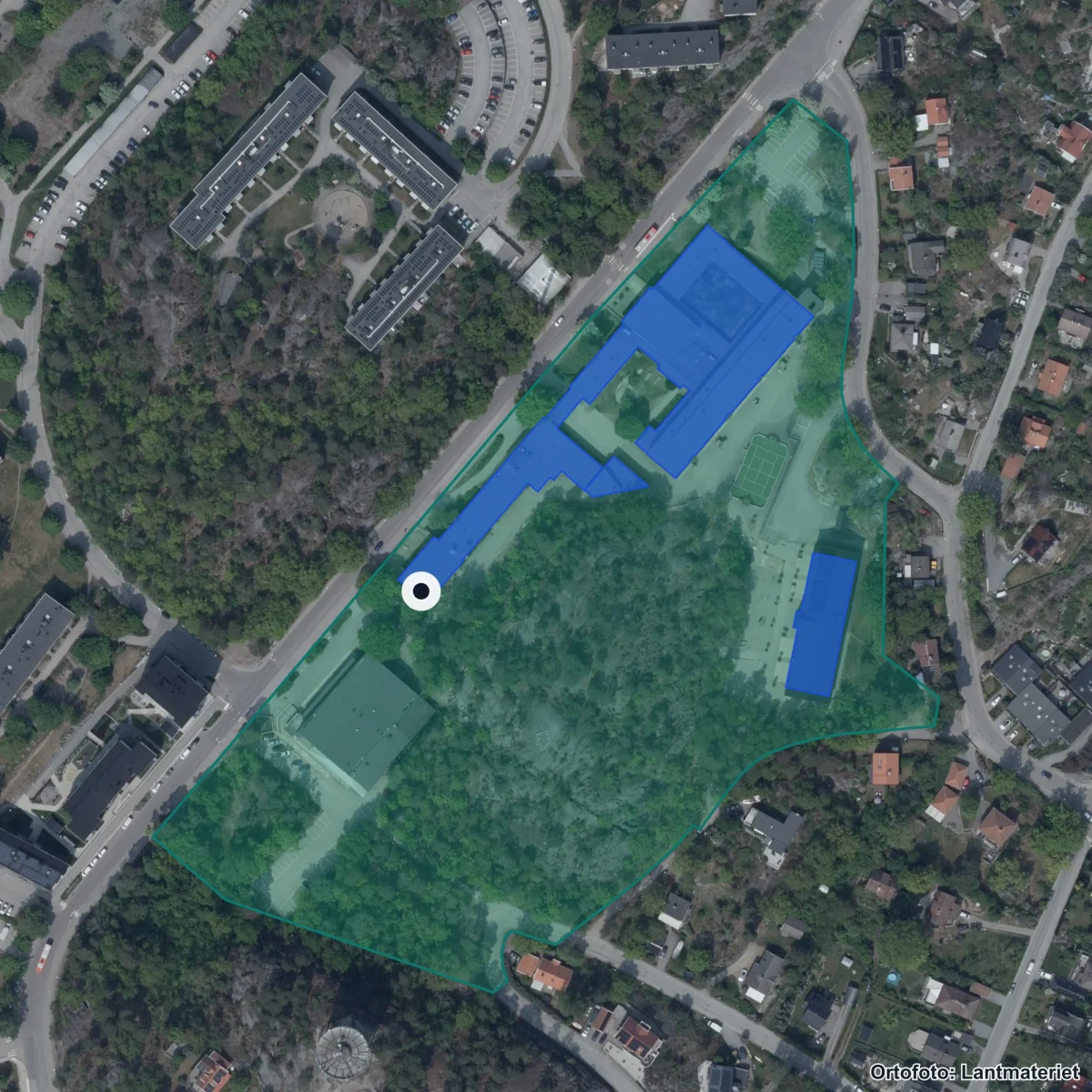
The school's property boundary and buildings from the Swedish Land Survey's property register. Updated 2026. Source: Lantmäteriet · CC BY 4.0
Entrances:1 Nynäshamn, Idunvägen 25, Nynäshamn
School performance
Results
236.2Merit value yr 9Sweden: 227.6
Results
236.2
Merit value yr 9
Results are reported by the school operator to Skolverket.
- SVA test-takers yr 6 Reliability: Moderate reliability.
- <10 test-takers (secrecy-suppressed)
- SVA test-takers yr 9 Reliability: High reliability.
- ≥10 test-takers
Moderate reliability — Direct data from the school operator.
Staff
68%Qualified teachersMunicipality: 69% · Sweden: 72% · Skolverket: unweighted school-unit mean, compulsory schools with published data; latest available value per school
Staff
68%
Qualified teachers
68% certified teachers — 4 percentage points below the national average.
High reliability — Reported directly by the school operator.
Value-added / SALSA
+1.0SALSA residualModel prediction: 219.0 · Actual outcome: 220.0
Value-added / SALSA
+1.0
SALSA residual
The school performs above what the student composition would predict.
- Model prediction Reliability: Moderate reliability.
- 219.0
- Actual outcome Reliability: Moderate reliability.
- 220.0
Moderate reliability — SALSA models have natural uncertainty for small schools.
School environment
Safety & Inspection
1 decisionsRecently inspected 2023
Safety & Inspection
1 decisions
Recently inspected 2023
1 registered inspection decision(s) with deficiencies.
- Latest inspection decision Reliability: High reliability.
- 2023-07-04 — Riktad tillsyn Uppföljning skolbeslut Grundskola Nynäshamn Gröndalsskolan F-9, 2023 (pdf, 764 kB)
- Recorded decisions with deficiencies Reliability: High reliability.
- 1
High reliability — Inspection register and Skolenkäten survey.
Source: Schools Inspectorate + Skolverket · Last updated: 5 Oct 2026
Resources
137,099 SEKCost per pupil (total)Sweden: 144,800 SEK
Resources
137,099 SEK
Cost per pupil (total)
Cost per pupil is 5% below the national average.
Limited history — Cost data updated annually by Kolada/SCB.
Who runs the school
Operator
NYNÄSHAMNS KOMMUNMunicipal operator34 other schools in the municipality.
Operator
NYNÄSHAMNS KOMMUN
Municipal operator
NYNÄSHAMNS KOMMUN is the operator. The municipality has 34 other schools.
- Operator Reliability: High reliability.
- NYNÄSHAMNS KOMMUN
- Operating form Reliability: High reliability.
- Municipal own operation
- Other schools in municipality Reliability: High reliability.
- 34
High reliability — Current data from Skolverket and Bolagsverket.
Source: Skolverket · Last updated: 5 Oct 2026
Next step: Apply for a place
Apply through Nynäshamn e-service for school choice.
Contact and address
- Visiting address
- Idunvägen 23, 14931 Nynäshamn
- Postal address
- 14981 NYNÄSHAMN
- Phone
- 08-52073600
- School unit code
65717061
Source: Skolverket School Unit Register · Pipeline-fetched on 2026-10-05.
Everyday travelAreas that reach the school within 15 minutes.
Reachability from the school
15 min on foot
15 min by bike
School
Support and inclusion
Support and student health
This panel shows sourced support-resource data where available and marks the rest as missing or uncertain. These fields do not affect score or ranking.
Missing or uncertain support-resource fields
- MissingStudent health teamIs there sourced information about student health functions at the school?
- PartialSpecial educatorThe source does not split special educators and special needs teachers per school unit in this model.
- PartialSpecial needs teacherThe source does not split special educators and special needs teachers per school unit in this model.
- MissingSchool nurseIs there sourced information about school nurse resources?
- MissingPsychologistIs there sourced information about psychologist resources?
- MissingStudy and career guidanceIs there sourced information about study and career guidance?
- MissingLanguage supportIs there sourced information about language or mother-tongue support?
- MissingAdaptations and special supportIs there verified process information for adaptations and special support?
- MissingAccessibilityIs there sourced information about physical or pedagogical accessibility?
- MissingContact routeIs there a verified contact route for support questions?
Privacy rule: no individual pupil health, diagnosis, support decision or personal case data may be stored.
Nearest and similar schools
- Internationella Engelska Skolan Enskede41 km away· 900 pupils
- Skarpnäcks skola44 km away· 840 pupils
- Fornuddens skola38 km away· 810 pupils
About Nynäshamn municipality
School-form averages across the municipality, with links to deep-dive sub-pages.
- Schools
- 35
- Avg. merit (yr 9)
- 227.7in line
- Certified teachers
- 69%−4 pp
- Pupils per teacher
- 15.7+3.8
Source: Skolverket (aggregated school statistics).
Similar schools
The 5 most-similar compulsory schools based on student count, geography, teacher certification and pupil composition.
Grade distribution
Share of pupils per grade, school year 2025/26.
+0.3Grades close to national-test results — no clear inflation signal.
Source: SIRIS/Skolverket · See full A–F distribution in the data view →
School survey perspectives
Pupils, guardians and staff — same school, different answers
Survey results broken down by respondent group on a 0–10 scale. Groups can experience the same school very differently — notable gaps are highlighted below.
PupilsGuardians
Text summary of the chart:
- Pupils: Safety 7.5, Study environment 5.2, Stimulation 5.3, Support 6.3, Anti-bullying 4.7.
- Guardians: Safety 5.8, Study environment 3.8, Stimulation 5.3, Support 5.3.
Automatically flagged gaps
Guardians report lower safety (5.8) than Pupils (7.5). (on the 0–10 scale)
Guardians report lower study environment (3.8) than Pupils (5.2). (on the 0–10 scale)
Guardians report lower support (5.3) than Pupils (6.3). (on the 0–10 scale)
Staff results are not published per school by Skolinspektionen today, so the staff view appears only when available.
SALSA result
+1.0A statistical model that compares schools’ results with what is expected given the student composition.Read more in glossary →Performs as expectedThe residual is actual minus expected merit value; positive means the school lifts pupils more than the model predicts.
How should SALSA be read?
SALSA is a statistical comparison metric, not a school rating. Small cohorts and individual year groups can create uncertain signals, so read it together with pupil counts, survey data and other sources.
Source: Skolverket/SALSA · See the full comparison table →
Pupils per year
Number of pupils per year group (total 877 pupils). Latest available year from Skolverket (SIRIS).
★ Watch Gröndalsskolan
Get email when new statistics are published, merit value changes significantly or the School Inspectorate makes a new decision.
Want to dig deeper?
The Data view shows complete history, sources, methodology and CSV export.
In-depth metrics
Staff stability
Improving
Source: Kolada (municipality-aggregated certified teacher trend).
Throughput year 6 → year 9
60.7% → 86.6%
- 50 pupils yr 6
- 172 pupils yr 9
Source: Skolverket SIRIS + Skolverket Statistical Database.
Trend over time
Safety and study environment over time
Trends are shown only when the same indicator and source has at least two comparable years. Missing years, too few responses, and low response rates are marked.
Safety
+0.5change between first and latest comparable year
- 20247.4
- 20267.9
Source: Pupils year 8 · missing years: 2025
Study environment
-0.3change between first and latest comparable year
- 20245.3
- 20265.0
Source: Pupils year 8 · missing years: 2025
School meals
Weekly menus and meal provider for this school's municipality.
Meal menu provider: Skolmaten.se
Kommunen publicerar skolmenyer via skolmaten.se.
No menu provider registered for this municipality yet.
Source: municipality's own meal portal — Skolkoll does not host menu content.
Inspections & decisions
Source: Skolinspektionen tillsynsregister (open data). Updated when new decisions are published. · See all decisions and review types in the data view → · Check current status at the Schools Inspectorate ↗
Explore further
More context about Gröndalsskolan, its municipality, operator and similar schools.
Compulsory schools in NynäshamnSee all compulsory schools in the municipality with results and comparisons.Schools in NynäshamnOpen the municipality page with all schools, rankings, and local aggregates.Nynäshamns kommunSee all schools, municipalities, and core metrics for the same provider.Stockholms länCompare municipalities and school patterns across the whole county.Merit value year 9Compare year-9 merit values across municipalities and school environments.Certification vs Merit valueSee how the share of certified teachers relates to year-9 merit values.School size by school typeSee how school forms and unit sizes are distributed nationally.School type distributionCompare how school forms are distributed across municipalities and operators.
Data coverage
What we do not know about Gröndalsskolan
Open school data is not complete. Use this as a checklist for what to verify with the school, provider or municipality.
- MediumResults and score inputsMedium data coverage: 3 of 5 score dimensions have school-specific data. When school-specific data is missing for a dimension, the neutral value 50 is used. That does not automatically lower the school, but it makes the score less informative.
- MediumEligibility and goal attainmentGrades, eligibility and goal-attainment data may be missing, suppressed or available only for some grades and school types.
- UncertainResources, teachers and staffTeacher and resource metrics do not always show subject mix, vacancies, student-health workflows or everyday staffing.
- PartialSupport resources and student healthSome support-resource fields have sourced statistics, but several parts are still missing or reported only in aggregate.
- MissingSafety and study environmentWe lack current or displayable survey data about safety and study environment for this school.
- UncertainAdmissions, placement and important datesMunicipal placement rules, queues and important dates require a local source and should be checked with the municipality or school.
- MissingVisits, facilities and everyday environmentWe lack sourced open-house information for this school. Facilities, accessibility and everyday environment are often not open comparable data.
For the school: get your Skolkoll badge
Work at this school? Embed an image showing the school's Skolkoll score that links to the full profile. The image is served from Skolkoll's image host and updates when we publish a new badge for the school.
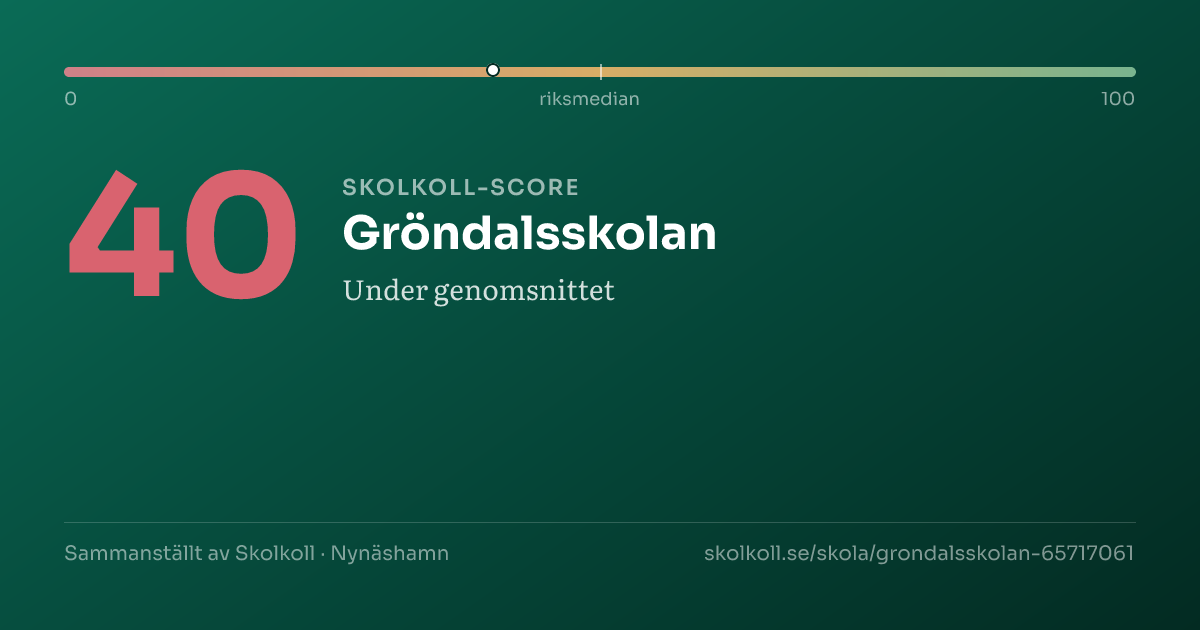
See Data view for full sources and fetch dates per source.
